Board members step into their roles with the best intentions, ready to serve their communities. What they don’t always anticipate is the sheer volume of administrative work, from tracking down overdue assessments, documenting architectural requests, following up on covenant violations, coordinating with the vendors, and answering homeowner questions. For many HOAs, the default approach is still analogue.
Violations get logged in spreadsheets and handwritten notes, communications happen through email chains, printed notices, and bulletin boards, and meeting minutes live in binders. Assessment tracking involves manual ledgers and reminder calls. Although these traditional methods might work for some time, they don’t scale as communities grow or board volunteers turn over.
For example, you will start noticing violations going unrecorded because someone forgot to update the spreadsheet, or a homeowner never received a notice because it was posted on a bulletin board they never checked. Financial discrepancies then arise from manual calculation
errors.
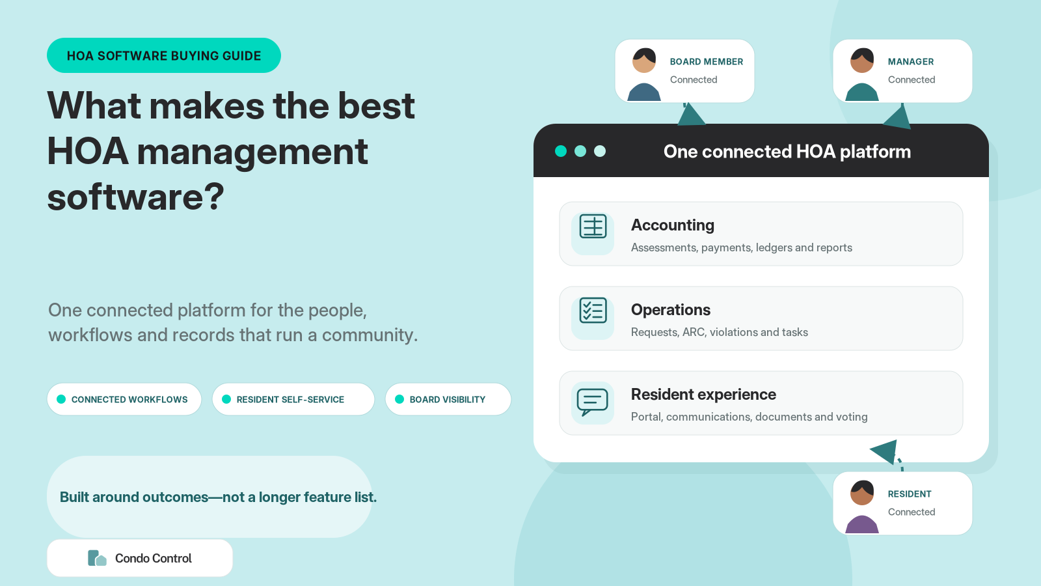
The good news is that HOA management doesn’t have to be this way. HOA management automation is the modern solution that transforms how communities operate. By digitizing and streamlining core functions, boards can reduce errors, improve transparency, and free up time to focus on what actually matters, such as building a cohesive, transparent, and well-maintained community. In this guide, I’ll break down the core areas where automation makes the biggest difference and how you can implement it in your community.
Violation tracking

Every HOA operates under CC&Rs, bylaws, and rules and regulations. These documents exist to protect property values, maintain aesthetic standards, and ensure that everyone in the community follows the same playbook. When residents violate these rules, whether it is unapproved paint colors, overgrown landscaping, or improperly stored trash bins, boards have a responsibility to enforce standards. But the challenge is enforcing these rules fairly and consistently.
When inspections are done on paper, notices are drafted individually, and follow-ups rely on someone remembering to send them, you end up with gaps. And those gaps open the door to selective enforcement, whether intentional or not. For example, one homeowner gets cited for an overgrown lawn, while another with the same exact issue doesn’t hear a word. From the outside, that looks like bias. And when homeowners feel the rules aren’t being applied fairly, it erodes trust in the board. In fact, a recent research we conducted found that 43% of HOA residents view enforcement as unfair, compared to just 38% who see it as fair.
Automation directly addresses this by standardizing the entire enforcement workflow. With the right automation tools in place, boards can:
- Centralize the entire process: Inspections, notices, appeals, and follow-ups or live in one system. When information flows seamlessly between field activity and office workflows, nothing gets lost or conveniently forgotten. That means no homeowners will escape the radar of violation enforcement.
- Conduct GPS-enabled inspections: Mobile inspection tools with location tagging and timestamped photos create an objective, verifiable record of every violation. That documentation works as proof that the enforcement was fair as per the governing documents.
- Automate notices and cure period tracking: Once a violation is logged, the system generates the appropriate notice, tracks deadlines, and sends reminders without anyone having to manually manage the timeline.
- Maintain a complete audit trail: Every action taken, from initial inspection to final resolution, is recorded. This protects the board as it demonstrates transparency to residents and makes appeals far easier to manage.
Communication
If I had to identify the single biggest pain point across every community I have worked with, it would be communication. Not because boards and managers don’t care about keeping homeowners informed, but because the traditional tools at their disposal simply aren’t built for how people consume information today.
For example, many HOAs rely on printed newsletters mailed quarterly, and end up arriving sandwiched between credit card offers and pizza coupons. Community bulletin boards only get seen by a few of the residents who regularly visit the amenity center. And meeting announcements reach maybe 20% of homeowners. Email blasts end up in spam folders. These methods are inconsistent, inefficient, and increasingly out of step with how people actually communicate.
Meanwhile, the average person checks their phone around 96 times a day. People are used to instant updates through push notifications and SMSs, and that’s what you should aim to take advantage of. Here’s how automation can help you:
- Email and SMS notifications: Automated alerts allow boards and managers to push time-sensitive updates directly to homeowners. Emergency notices, rule reminders, and event announcements are delivered instantly through SMS. Emails and SMS also cut down on paper costs and the labor involved in physical mailings.
- Centralized community portal: Rather than scattering information across emails, printed documents, and in-person announcements, a digital portal serves as your single source of truth. Homeowners can log in any time to access governing documents, meeting minutes, architectural guidelines, event calendars, and community news. It is like giving every resident a 24/7 HOA information desk.
- Mobile apps: A dedicated mobile app puts your entire community in homeowners’ pockets. They can submit maintenance requests, pay assessments, book amenities, receive push notifications, and communicate with management, all from the same device they are already using many times a day.
- Self-service knowledge base: In HOA management, you will have the same questions asked by different people many times a year. And each time, someone on the management side has to stop what they are doing to respond. AI-powered resident self-service Q&As give homeowners answers to questions about processes, amenities and rules, without having to wait for a manager or a board member to reply. The system draws from your communities governing documents and posted information, so the answers are accurate and tailored to your question, not generic.
- Management co-pilot: Instead of the management taking time to create notices and announcements, AI communication co-pilot drafts them, and the management only needs to review, adjust where needed, and then send.
Document management
If your HOA is still running on filing cabinets and physical document storage in 2026, you are behind the curve and risking compliance issues. Physical records get misfiled, damaged, or lost. Board members spend more time hunting down a document than actually acting on its content. And when there is a transition in the board leadership or management, critical institutional knowledge walks right out the door in a banker’s box.
The regulatory landscape is also shifting. For example, Florida’s House Bill 1203, which took effect January 1, 2025, requires HOAs with 100+ homes to maintain a publicly searchable online portal where owners can access governing and financial documents without jumping through multiple logging hoops. Florida isn’t alone in moving this direction, and if your state hasn’t enacted similar requirements yet, it is likely only a matter of time.
Beyond compliance, the operational efficiency of automated document management is straightforward. When everything lives in a centralized digital system, it only takes seconds to retrieve the document. Here is what a modern document management setup looks like for HOAs.
- Cloud-based storage: It gives boards and managers secure, anywhere access to governing documents, financial records, vendor contracts, and meeting minutes. Encryption and multi-factor identification protect sensitive information, and nothing is lost in case of disasters like floods and fire.
- Integrated HOA management software: This option takes cloud-based storage a step further by housing documents within the same platform you are using for everything else. Instead of toggling between systems, records are connected to the relevant workflows. For instance, a vendor contract lives alongside the vendor’s work orders.
- Digital filing with structured organization: This option replicates the logic of physical filing systems without the physical limitations. Folders, subfolders, and document indexing make it easy to locate exactly what you need.
- Secure sharing portals: This allows you to get documents to homeowners, vendors, or legal counsel quickly and safely, with tracking that tells you when a document was accessed and by whom. That means you’ll no longer struggle chasing down signatures or wondering whether someone actually received what you sent.
Fees collection
HOA fees fund the things that make a community worth living in, such as landscaping, amenities, shared infrastructure, reserve funds for major repairs, and insurance. Collecting those fees reliably and efficiently is one of the most important things a board or management team does. And yet, I still encounter communities handling this process almost entirely by hand.
Cash collection is the most problematic scenario I come across. Beyond the obvious security concerns of storing cash on-site, it creates an accounting nightmare. There is no automatic paper trail. Deposits have to be made manually. Every transaction requires manual reconciliation in your management software. And door-to-door collections are even worse. Nobody wants a knock on their door, only to open and find a board member coming to collect money. And other than that, homeowners are busy, and you can’t tell when you’ll find them at home.
Automation transforms this entire process. The management software generates an invoice and sends it to the homeowner. It also sends a notification and reminder notifications in case of delays. From there, residents pay through an online portal or mobile app using whatever method works for them, such as credit or debit card, ACH bank transfer, and other digital options. Payments are recorded automatically, and statements update in real time.
One feature worth mentioning is that some systems even support automated recurring payments. That means homeowners can opt in to auto pay through the self-service portal, and the system will automatically deduct money from their bank account without manual intervention.
Maintenance management
The maintenance function in an HOA is where I have seen the most operational stress and the most visible impact from automation. Board members and managers are responsible for keeping common areas in good condition, such as coordinating across HVAC systems, plumbing, electrical, roofing, elevators, and landscaping.
Without a structured system, maintenance requests pile up. Priorities get set by who is the loudest rather than what is most urgent. For example, a homeowner reports a small leak. The mail gets buried, and days pass. The leak worsens, and by the time someone responds, there is water damage. Now you’ll not just be fixing a leak, you’ll be dealing with drywall replacement, mold remediation, and angry homeowners.
With automated maintenance management, residents can submit requests directly through a portal or app, attach photos, videos, and descriptions that give your team the context they need before anyone sets foot on the property. The system logs the request, time-stamps it, and triggers whatever workflow you have configured. You can even set up smart auto reply rules. For instance, if a resident submits a request containing keywords like “running toilet”, the system can instantly respond with troubleshooting steps that help resolve simple issues before a vendor is dispatched.
Invoice processing
In HOA management, you will always deal with vendor invoices for things like landscaping, repairs, utilities, insurance, and professional services. You need to process them accurately and on time to maintain good vendor relationships and financial integrity. Surprisingly, processing an invoice is more expensive than many people think. Industry research has put the cost of manually processing a single invoice between $10 and $15 when you factor in labor, printing, storage, and the time spent on routing and approvals. Across hundreds of invoices per year, it is a large amount of money.
The inefficiency goes beyond cost. Manual data entry introduces errors, such as wrong amounts, duplicate entries, and misapplied payments, that can cause overpayment or disputes with vendors. And when something goes wrong, tracing the error through a paper-based system is painful. Invoices that travel through email chains or require physical sign-off from multiple board members create delays, considering that board members have daily jobs and families to take care of, and getting them in person to sign the invoices is hard.
Automated invoice processing addresses these problems through tools such as OCR technology and machine learning. These systems capture invoice data automatically, match invoices against purchase orders and contracts, and flag discrepancies. If everything aligns, the system sends a notification to approvers, and they can approve the invoice from anywhere through their mobile phones. Then everything from invoice submission to approval and payment is stored centrally, with a clear audit trail that makes financial reviews and audits far less stressful.
Analytics and reporting
Sound financial reporting is the backbone of HOA governance. Without it, a board has no reliable way to know whether it is staying within a budget, whether its reserves are adequately funded, or whether spending trends are heading in a bad direction. In many states, it’s also a legal obligation. For example, Illinois requires HOAs under 765 ILCS 160/1-30 to maintain detailed financial records and gives homeowners the right to inspect them.
Beyond compliance, transparent financial reporting builds homeowners’ trust. When residents can see clearly how their money is being spent, they are more likely to support board decisions and less likely to question the management.
However, the challenge has always been that producing accurate, GAAP-compliant financial statements, such as balance sheets, income statements, cash flow reports, general ledger summaries, and delinquency reports, requires both financial expertise and significant time. Many volunteer board members simply don’t have either.
The good news is that with automation, you don’t need a CPA on the board to get a compliant financial statement. When all of your financial data lives inside a single management platform, you can generate reports instantly, accurately, and in all formats that comply with GAAP standards, at a single mouse click.
AI-powered tools go a step further, summarizing monthly reports, flagging variances from budget, and surfacing areas where the community is over- or underspending. For members without a financial management background, this kind of plain language insight is helpful in making them understand the complex data into clear and actionable information.
Forecast and budgeting
Budgeting is one of the highest-stakes responsibilities an HOA board carries. If you get it right, the community runs smoothly, property values hold, and owners feel well served. If you get it wrong, you end up with special assessments, deferred maintenance, and credibility problems. The traditional approach has been using spreadsheets to try to predict future expenses and income. This is technically hard when the board doesn’t have good financial analytical skills. Also, when board members change, the knowledge about the past spending patterns disappears, and the new board might have issues predicting the future.
Automation and AI change things. AI-powered platforms can analyze years of historical financial data alongside market trends to produce more accurate expense projections. AI can even make predictive maintenance planning by analyzing data from maintenance logs, equipment usage, and even environmental factors. This helps boards and managers determine what to prioritize in the budget.
Final thoughts
After working in this industry for over a decade, my perspective on automation is simple: spare human judgment for tasks that really need human intervention, and let AI take over all the time-consuming, routine tasks. And when I look at legal trends across many states, authorities are constantly pushing for HOA management automation with the aim of improving financial management and transparency. Instead of waiting until you’re caught up with compliance issues, I strongly suggest you implement an automated HOA management system as early as now.