As you already know, dues aren’t the whole picture. Yes, monthly or annual assessments are the backbone of your operating budget that fund landscaping, reserve contributions, shared amenity upkeep, and the day-to-day work of keeping a community running. But they’re not the only money moving through your association. There are other streams like special assessments, violation fines, and amenity rental fees. But we recently discovered some shocking statistics.
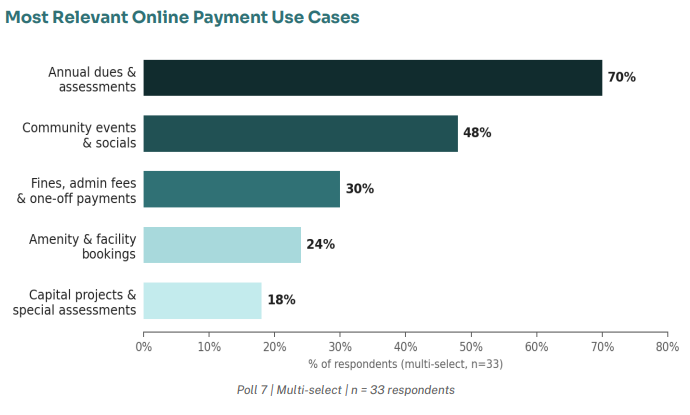
In a webinar we held, 70% of HOA board members and community managers identified annual dues and assessments as their most relevant online payment use case. That tells you that if dues are the only payment type most boards have modernized, every other revenue stream is still running on the old and inefficient infrastructure of paper checks in the mail, trips to the bank, manual ledger entries, and cash during events. And these traditional collection methods go deeper than inconvenience.
For example, check payments are a known target for fraud, where a thief intercepts a payment from a mailbox, chemically removes the payee and amount, and rewrites the check to themselves. Beyond fraud, the cost of processing a single check ranges anywhere from $4 to $20. When HOAs start collecting their dues online, they eliminate lag time, create predictable cash flow, and strip out the administrative burden.
But here’s the part most boards miss: Every single one of those inefficiencies, from delayed cash and missed fees to fraud exposure and hours of manual reconciliation, doesn’t disappear just because you modernized dues. It lives on, just as stubbornly, in every other payment your association is still collecting the old way. So, beyond dues, I’ll walk you through 4 payments your HOA should be collecting online.
Community events and socials

Your social committee works hard to plan the block parties, holiday dinners, pool parties, food truck festivals, bake sales, auctions, fitness events, and movie nights. From a financial standpoint, community events do real work for your association. Fundraisers can fund special projects, shore up reserves, and absorb unexpected expenses without triggering a special assessment. If your board is looking to avoid raising homeowner fees, events such as bake sales, plant sales, charity auctions, small concerts, and workshops offer a legitimate alternative revenue path.
Behind every one of those is a budget, a headcount, a logistics plan, and someone responsible for making sure the money adds up at the end of the night. And the appetite for handling these events digitally is growing.
In that same webinar poll, 48% of attendees identified community events and socials as a payment type they’d want to manage online. In fact, that was the second most selected use case, ahead of fines, amenity bookings, and special assessments. When we asked webinar attendees which specific event type they’d most want to manage through an online payment system, 63% pointed to community fundraisers. That’s telling.
Fundraisers carry a particular coordination burden of ticket sales, donation tracking, volunteer logistics, and financial reporting, all converging at once. It’s exactly the scenario where manual collection breaks down fastest. For instance, you get cash at the door, checks are dropped off ahead of time, and volunteers are cornering neighbors in the parking lot.
Also, handling large sums of cash introduces security risk. Secure storage and transport become a real consideration, especially when there’s no bank nearby to deposit funds after the event. Manual recording is time-consuming and error-prone, and reconciling payments against a registration list without automated tools is genuinely painful. Even when boards try to do it right, accurate cash handling means designating oversight personnel, enforcing dual counting, restricting who touches the money, and getting to a bank immediately after.
The RSVP problem
For free events, research shows organizers can lose more than half their registered attendees before the event even starts. No-shows inflate catering costs, skew seating arrangements, and drain the ROI out of events that took weeks to plan. The fix is surprisingly simple: paid events have a 40% lower no-show rate than free ones. Even a nominal registration fee changes behavior. When people pay for something, they show up for it.
How online collection solves the problem
When payment is built directly into the registration flow, attendees complete both steps at once, and the system handles the rest. You won’t need reminders about unpaid tickets, and you won’t have awkward conversations when a person shows up without the agreed-upon money. You also remove the risk of cash envelopes. Other than that, every transaction is recorded automatically, attendance is tracked digitally, and your board has clean financial records without anyone manually assembling them.
In fact, one webinar attendee asked whether Quick Pay could be activated on an event-by-event basis, such that it’s turned on when the social committee needs it, and stepped back when they don’t. That question reflects exactly how community leaders are starting to think about this: not as a rigid platform commitment, but as a flexible, on-demand capability. And that kind of flexibility is what you should be looking for when choosing an HOA payment platform.
Fines and admin fees
Fines are not primarily a revenue stream, but an enforcement tool. Without the ability to levy monetary penalties, your only real option when a homeowner violates the governing documents is a politely worded warning letter or an expensive legal action. Neither of those is sustainable. Fines are what make the rules real.
For example, noise complaints, landscaping neglect, unauthorized parking, and pet policy breaches happen in virtually every community, every month. Most HOA fines start around $25 and escalate to $50 or $100 for continued or repeated violations. The authority to issue them is almost always clearly spelled out in your governing documents. The problem isn’t authority. The problem is everything that happens after the fine is issued.
In our webinar poll, only 30% of attendees flagged fines and admin fees as a payment type they’d prioritize moving online. That’s a smaller share than dues or events, but I’d argue it understates the actual problem. In my experience, boards that are most frustrated by fine collection rarely identify it as a payment infrastructure issue. They chalk it up to difficult homeowners. Because here’s what actually happens after a fine is confirmed: most boards revert to paper. You start dealing with mailed invoices, phone calls, and spreadsheets.
Sometimes the math doesn’t even justify the effort. Think about the full cycle for a $25 fine: issuing the notice, following up, collecting the check, making a trip to the bank, and then reconciling it in your records. If you let a fine like that go because the operational cost outweighs the penalty, you’ve now created a selective enforcement problem. And if a different homeowner gets that same fine processed properly, you’ve created a fairness issue that can come back to haunt the board.
How online collection solves the problem
When fines are issued through a digital system, late penalties accrue and are enforced automatically, without anyone having to remember to add them, and they apply consistently regardless of the fine amount. For homeowners, the portal makes it easy to see exactly what they owe and settle it without a phone call and a check in the mail. And critically, you stop penalizing homeowners for things outside their control, such as a check that got lost in transit, a payment that cleared late through no fault of theirs. The system tracks what actually happened, not just what someone manually entered after the fact.
Amenity and facility bookings
Amenities are a core part of the value proposition of the properties. According to the National Association of Realtors, homes in HOA communities are worth 5 to 6% more than comparable non-HOA homes, and much of that premium comes directly from the amenities buyers expect. A peer-reviewed national study covering more than 34 million transactions found that HOA homes sold for at least 4% more – roughly $13,500 on average – than comparable properties without association membership.
And when we talk about amenities, we talk about things like pools, fitness centers, clubhouses, tennis courts, pickleball courts, and event spaces. And yet, for all the value these amenities generate, they’re frequently managed with some of the most outdated processes in the entire HOA operation. You’ll find things like paper sign-up sheets on a corkboard by the pool gate, phone calls to the office to reserve the clubhouse, and cash handed to a volunteer at the front desk for a guest pass.
If any of that sounds familiar, there’s a gap between what residents expect and what that process actually delivers. Your homeowners are booking vacation rentals, ordering takeout, and scheduling fitness classes through apps that confirm their reservation instantly. When your amenity management process involves a clipboard and a follow-up phone call, the disconnect is noticeable.
Interestingly, only 24% of webinar attendees selected amenity and facility bookings as a priority online payment use case, the second lowest of any category we asked about. I don’t think that reflects how small the problem is. I think it reflects how normalized the old way of doing things has become.
Without a centralized reservation system, overlapping bookings happen. Scheduling disputes arise. When the pool is at capacity, or the same group has been on the pickleball courts for three hours, trying to verify who submitted the proper forms and paid the right fees becomes genuinely chaotic, especially in larger communities with multiple amenities and high usage. Some associations hire additional staff just to manage guest passes and access, but those staff members end up splitting their attention between administrative tasks and actually monitoring the space. Even the most organized teams struggle when paper forms and cash payments are in the mix.
How online collection solves the issue
Online amenity management with integrated payment collection addresses all of this in one move. The platform lets you set availability windows, block off maintenance days, configure deposit requirements, and automate confirmations. Residents can reserve the clubhouse, pay the deposit, and receive a confirmation without a single phone call to the office. In fact, associations using HOA management software report up to a 25% increase in resident satisfaction and as much as a 40% reduction in administrative overhead.
Capital projects and special assessments
Of all the payments your association collects, none carries more financial weight and generates more homeowner anxiety than the special assessment. By definition, it arrives on top of what residents are already paying, and it almost always shows up in response to something they didn’t plan for, such as emergency repairs after storm damage, a roof replacement that the reserves couldn’t fully cover, road repaving, pool resurfacing, structural reinforcements, and insurance premiums that have climbed faster than the budget anticipated.
It may be telling, then, that in our webinar poll, only 18% of attendees selected capital projects and special assessments as their top online payment priority, the lowest of all categories we asked about. I think it reflects avoidance. Special assessments are the payment type most likely to generate conflict, and a lot of boards would rather not think about the collection process until they’re already in the middle of one.
Communities that think ahead and build out a clear, organized collection process before a special assessment becomes necessary experience far less resistance when it does. And resistance is the thing you most need to plan for. When homeowners receive a special assessment without adequate explanation, the reaction is predictable: frustration, resentment, and in some cases, outright refusal to pay. That refusal triggers disputes, lien filings, and legal costs that can far exceed the original assessment amount.
The assessment itself isn’t always what breaks trust, but it’s how it’s communicated and how payment is structured. For example, research shows that boards offering 6 to 12-month installment plans collect 25 to 40 percent more on schedule than boards that demand a lump-sum payment. And yet many boards still issue a single paper notice with a lump-sum demand and a mailing address to send a check.
There’s no payment tracker, no project progress update, and no way for a homeowner to log in, see what they’ve paid, confirm what they still owe, and understand where their money is going. What fills that void is the silence that breeds suspicion. In fact, I have recently seen so many Reddit posts about special assessments, and most of them are full of suspicion.
How online collection solves the issue
When special assessments are managed through your HOA platform, each homeowner can log in to a familiar dashboard, see their balance, review their payment schedule, and make payments without calling the office. Customized billing schedules mean you can offer installment plans that actually fit the size and scope of the assessment.
For instance, instead of a $3,600 lump-sum bill, you set 12 payments of $300. Automated late payment reminders go out without anyone having to track down who’s behind. And your treasurer gets a real-time view of exactly where things stand, such as who’s current, who’s overdue, and how much remains outstanding. When someone can log in and see a clear payment schedule tied to a project they understand, it stops feeling like an ambush and starts feeling manageable.
Final thoughts
Community events, fines and admin fees, amenity bookings, and special assessments happen in virtually every association, every year. They involve real money, real administrative effort, and real exposure to the same inefficiencies of delayed cash flow, manual tracking, missed charges, and fraud risk. Here’s a simple question worth sitting with: the last time a homeowner in your community had to pay for something beyond their monthly dues, how did they do it? Did they write a check? Bring cash to an event? Wait for a mailed invoice? If the honest answer is yes to any of those, your community has a payment gap.
The good news is that the infrastructure to fix all of this already exists. HOA management platforms today can automatically generate invoices and collect payments for dues, fines, late fees, event registrations, amenity bookings, and special assessments, and record every transaction to the ledger automatically. You only need to choose one that has this capability.