The HOA industry collectively manages over $90 billion in annual revenue across more than 370,000 community associations in the United States. That’s a mind-blowing amount of money, and yet, 75% of associations are still running their operations on tools like spreadsheets and paper files that haven’t evolved since the 1990s.
And the gap between what homeowners expect today and what most HOA payment systems deliver is wide. Today’s residents expect paying their HOA dues to feel as simple as paying a Netflix subscription. When it doesn’t, you end up dealing with late payments, follow-ups, and enforcing fines. Other than that, the cost of traditional payment systems is insane.
For example, manual check processing alone runs associations anywhere from $4 to $7 per transaction once you account for treasurer time, bank fees, and human error corrections. Then the late payments, many of which happen simply because residents forget to write and mail a check, create cash flow gaps that force boards to dip into reserves.
We recently polled more than 30 HOA leaders in a live webinar, and the results were pretty telling. Across four separate poll rounds, 76-100% of attendees described their current payment tools as “traitors”, with two of those rounds hitting 100%.
If you’re a volunteer board member juggling this on top of your actual job and personal life, you already know the burden. And if you manage a self-managed HOA with limited staff and resources, the margin for error is even thinner. So how do you know if your payment system is one of the culprits? Here are 5 red flags that your HOA payment system is failing you, and what you can do about each one.
Red flag #1: You can’t tell who has paid without cross-referencing a spreadsheet

I love to use a simple litmus paper test. Ask yourself: Can I tell you right now, without opening different spreadsheets or checking bank statements, which homeowners have paid their dues this month? If the honest answer is no, then your payment system is failing you.
What happens is this: board members collect checks, make trips to the bank to deposit them in batches, then manually log each payment into a spreadsheet. From there, someone has to reconcile those entries against the bank statement, match each payment to the right homeowner and ledger account, and then, only then, can you get a picture of where things stand.
Meanwhile, you cannot confirm to an owner whether their account is current, because there’s a lag between when the check arrives and when it actually shows up in your records. When it comes to time, collections and accounting tasks eat up 25-40% of a community manager’s workload.
For a 100-unit association using semi-manual processes, that’s 8 to 25 hours every single month just on fee tracking and collections. Add in the time it takes to generate delinquency reports, which averages another 1 to 2 hours per week, and you’ll have over 10 hours just to answer the question of who hasn’t paid.
A lot of this comes down to using the wrong tools. Systems like QuickBooks and Excel weren’t designed for HOA management. They weren’t built to track dues, fees, special assessments, and owner ledgers the way an HOA actually operates. The result is double data entry, reconciliation confusion, and inconsistencies that take time to clean up.
Solution
The solution is as simple as getting a payment system purpose-built for HOA management. With such a system, the past-due owners are flagged automatically – you don’t have to hunt for them. Then, the online payment options like ACH, eChecks, and credit cards eliminate the lag that comes with mailing and depositing checks. Payment statuses update in real time and display in a single dashboard, so any board member and manager can see exactly where every account stands.
Red flag #2: your payment data doesn’t talk to your accounting software
A lot of HOA boards land on QuickBooks as their accounting tool because it’s familiar. And, honestly, QuickBooks is the most widely used small business accounting software in the world. But familiarity and fit are two very different things.
QuickBooks was not built for HOA accounting. It’s a general-purpose tool, and HOAs are not general-purpose organizations. Take something as simple as tracking ownership. QuickBooks is designed around customers – HOAs deal with units and homeowners, and those aren’t the same thing. Every time a unit changes hands, you have to create a new customer record. Over time, you end up with multiple customer profiles tied to the same address, and you can’t pull documentation by unit, only by customer. It gets messy over time.
There’s also the resident experience angle. QuickBooks has no homeowner-facing portal. No place where a resident can log in, check their balance, and confirm their last payment. Every single inquiry, even something as simple as “did my check clear?” requires the treasurer to stop what they’re doing and look it up manually.
Interestingly, so many boards try to solve this by adding a separate online payment platform on top of their accounting software. In reality, you’ve just created a gap that a human being has to fill manually.
A payment comes in through the portal, gets recorded there, and then someone has to re-enter that same transaction into QuickBooks by hand. Every single time. The industry average for manual data entry errors runs between 1% and 4%, and when your books are the foundation of your financial reporting, those small errors compound, and you won’t be able to explain what happened.
Just to make you see how important this integration is, in the webinar we conducted, 67% of attendees said accounting system integration would be a deciding factor when choosing a new payment tool. And that number makes sense. QuickBooks alone was brought up five separate times in the Q&A, making it the single most-requested integration. People aren’t asking for bells and whistles. They’re asking for their systems to simply talk to each other.
What good integration looks like
The fix isn’t about abandoning your accounting software, but getting a payment platform that integrates directly with your accounting system. That way, payments captured in the homeowners portal flow automatically into the books.
Red flag #3: You’re not sure what fees are being charged or who’s absorbing them
Every dollar that moves through your HOA’s payment system has a cost attached to it. The real question is whether your board actually knows what that cost is, where it goes, and who ends up paying it. If you’ve ever sat through a budget meeting struggling to explain why collected dues don’t match projections or dealt with a homeowner upset about a fee they didn’t expect, you have a transparency problem.
In our webinar, fee transparency was one of the top concerns attendees raised: questions about what fees apply, whether they could be passed to residents, and how refunds are handled. Your payment system is likely at the center of it.
Here’s how payment systems can get you into transparency issues. When homeowners pay by credit card, processors charge between 2% and 3% per transaction. Take a mid-sized community of 400 homes paying $250 a month in dues. That’s over $1.2 million processed annually. At a 3% processing rate, you’re handing over $36,000 a year in payment fees alone, just to collect the money you’re already owed.
And yet, a lot of boards haven’t decided whether the association absorbs those fees or passes them on to homeowners as a convenience charge. They haven’t communicated the policy to residents. Some boards haven’t even confirmed whether cheaper options like ACH and eChecks are offered or easy to use in their current system. The result? Homeowners default to credit cards without realizing they’re choosing an expensive path.
Solution
The goal isn’t necessarily to eliminate all transaction fees – that’s not always realistic. The goal is knowing exactly what you’re paying, making a deliberate policy decision about who bears the cost, and communicating that. Your payment platform should surface fee structures transparently, allow you to configure who pays what based on payment method, and make lower-cost options like ACH easy to find and use. And steer clear of systems that bury fees in long-term contracts and vague maintenance charges.
Red flag #4: Residents who struggle with technology have no way to pay without it
This is a failure mode that boards rarely name out loud, because it’s easy to misread as a resident problem rather than a system problem. But let me reframe it: if a homeowner can’t complete a payment without full technical independence, your system has a gap, and that gap is your association’s responsibility to address.
Let me first show you how serious this problem is. According to the Pew Research Center, one in four adults over 65 doesn’t use the internet at all, and more than 35% lack a home broadband connection. Even among seniors who are nominally online, usage is limited and task-specific, averaging fewer than three hours a week. The reasons are layered: cognitive changes that make learning new digital tasks harder, fear of making mistakes, and fear of falling for scams online.
In HOA communities, particularly 55+ communities, this will be a large portion of your homeowners. And the senior population in HOAs is growing, not shrinking, for that matter. In our webinar, one attendee specifically asked whether there was an admin-side option to process payments on behalf of residents who aren’t tech-savvy. That question tells you everything. If your payment system can’t accommodate that scenario, you’ve locked a portion of your community out of a reliable and convenient payment path.
The downstream effect is that those residents fall back on paper checks, which cycles back to the manual processing burden we talked about in Red Flag #1.
Solution
The answer isn’t abandoning digital payments. It’s designed for the full spectrum of your community. Your payment system should offer multiple methods such as ACH, eChecks, credit and debit cards, and mobile wallets, so homeowners choose what works for them. It should support recurring and scheduled payments, so a family member or board member can help a resident get set up once and let the system run on autopilot from there. On top of that, the payment system should be backed by 24/7 customer support.
Red flag #5: You’re running dues, fines, and events out of completely separate systems
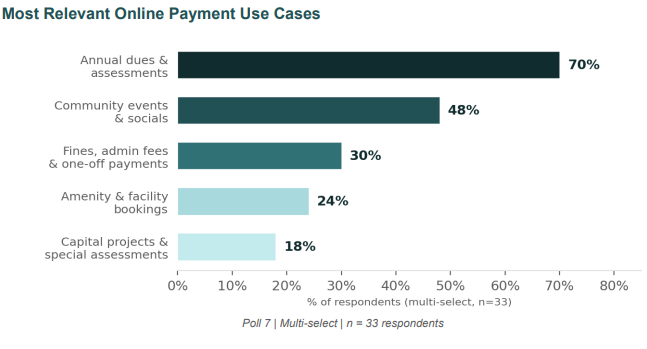
Walk through the typical week of an HOA treasurer or community manager without unified software, and you’ll see the same exhausting pattern on repeat. Dues tracked here. Violation fines were issued and followed up on somewhere else. Then event registrations and facility booking fees live in yet another spreadsheet or shared inbox. Each piece is isolated.
This fragmentation doesn’t happen by design, but it happens by addition. The community starts with a basic dues collection method. Then adds a separate tool when board members get tired of manually emailing fine notices. Then tacks on an event form or booking platform. Each addition made sense at the moment. But the cumulative result is a patchwork of disconnected systems, each holding a different slice of your community’s financial picture, and none of them telling the complete story.
The time cost of this is huge. If we take general statistics, employees waste an average of 12 hours per week simply searching for information spread across disconnected systems. For a mid-sized business, that translates to over $1.2 million annually in lost productivity. HOAs operate at a smaller scale, but the principle holds completely: every hour spent manually exporting data, chasing down a fine that was issued in one tool but paid in another, or reconciling mismatches between platforms is an hour volunteered by a board member or paid for, and got nothing useful out of.
On top of that, without a centralized owner ledger that reflects dues, fees, fines, credits, and assessments for each homeowner in a single view, your financial picture is always incomplete. And incomplete financial pictures lead to real decisions made on bad information.
The fix
The fix isn’t adding another tool to the stack. It’s replacing the stack altogether with a single, purpose-built platform that handles every financial transaction, from recurring dues, special assessments, and violations to events and facility fees, under one homeowner ledger, with one reconciliation process. When everything lives in one place, your financial reporting becomes something you generate instead of something you construct. And your homeowners get a single, accurate view of where their account actually stands.
Final thoughts
As a board member or property manager, you carry the entire association’s financial responsibility, not just about collecting dues on time. You handle finances related to fines, violations, events, facility use, and special assessments. If your current system doesn’t allow you to automate and track all of these tasks from a single platform, or you notice one or more of the above red flags in your operations, then your payment system is failing you. The good news is that the problems are well understood, and the solutions exist. Get a unified, purpose-built HOA platform that brings payments, accounting, violations, events, and reporting together in one place.