Being on an HOA board isn’t what it used to be. What was once a manageable role has evolved into something far more demanding. Board members nowadays face rising expenses that need more professional budgeting, tighter regulations, higher homeowner expectations, and communities that are more complex.
Don’t forget that most board members are volunteers. They raise their hands because they love their neighborhood, not because they hold degrees in finance, know state housing laws inside out, or have backgrounds in construction or mediation. Yet somehow, they’re expected to manage budgets that can reach thousands or millions of dollars. They enforce community rules, supervise contractors, plan for major repairs years down the road, and keep everyone in the loop and happy.
Take financial management as an example. Most board members don’t have formal training in this area, and that’s why the biggest headaches crop up around finances. Boards handle significant sums. Homeowners pay around $291 each month, which adds up to roughly $3,500 per year in association fees. That money goes toward maintaining common areas, providing security services, covering insurance policies, and building up reserve funds for projected repairs and improvements. That’s a massive amount of cash being managed by people who never studied accounting.
And money isn’t the only challenge. I’ve seen communication breakdowns happen regularly. Time is always in short supply, and expectations aren’t always clear. But here is encouraging news: technology is changing how community associations operate, bringing tools and systems that make management simpler, improve how boards communicate with residents, and help build tighter-knit communities.
Technology’s biggest impact on community associations comes through better communication and smoother operations. HOA websites and digital portals have become the preferred method for collecting fees, handling maintenance requests, and keeping in touch with residents. In this guide, I’m going to show you how community association board members can use AI to automate key tasks, reducing time pressure, closing communication gaps, and tackling financial management challenges.
Key things association boards should automate using AI
As AI continues to advance, more community associations are discovering the efficiency, speed, and value that AI brings. Some of these capabilities weren’t available even 18 months ago. Let me break down what AI actually means. It’s the creation of computer systems that can handle tasks we normally associate with human thinking. This includes making decisions, recognizing patterns, and solving problems. AI can examine large amounts of data, spot trends, and generate predictions at speeds humans can’t simply match.
The technology takes care of repetitive, time-consuming work, supports better decision-making, and enhances what board members can accomplish. Let me walk you through the main areas where boards should be implementing AI automation.
Communication
Good communication is the pillar for any well-run community. When communication falls apart, you get confusion, frustration, and eroding trust among homeowners, which eventually weakens the entire community’s foundation. For instance, homeowners get mixed or vague messages about critical matters like when maintenance is scheduled, what policy changes are happening, or when community events are taking place. This creates confusion, annoyance, and doubt about whether management can actually communicate effectively.
Many communities still lean on old-school communication methods, such as physical bulletin boards, paper notices, and occasional email blasts. These outdated approaches slow down how quickly information gets shared. Using inefficient communication tools creates delays in responding to homeowners’ questions and concerns. Issues start stacking up without being resolved, residents get dissatisfied, and the community manager’s workload multiplies because they’re manually tracking and answering every single inquiry.
In a recent study we did, we found that residents are split down the middle on how transparent their governance is. About 36% of residents say they feel out of the loop when it comes to board decisions.
How to automate communication and resolve these bottlenecks
Right now, AI’s most powerful use case is automating how boards communicate with homeowners. This covers everything from answering everyday questions to scheduling facility bookings and creating work orders. This lightens the load for community association board members while speeding up responses and making residents happier.
Here’s how board members can automate administrative work and communication tasks to fix problems with unclear, outdated, and inefficient communication strategies.
- Portals: Setting up centralized platforms ensures all messages are clear, consistent, and easy to find. The portals can have pre-written message templates and automated notifications to keep everything uniform, cutting down on confusion.
- Mobile apps: Using digital solutions like mobile applications, dynamic forms, and social media connections enables real-time updates and instant access to important announcements. These tools guarantee everyone stays current on maintenance schedules, policy updates, and community happenings.
- AI chatbots: AI-powered software platforms provide streamlined communication channels that deliver quick responses and efficient handling of homeowner issues. One of the best features of AI-powered systems is AI chatbots. These chatbots provide automated replies, which ensure problems get addressed promptly, cutting down delays and boosting resident satisfaction.
- Online polls and surveys: Interactive features like polls, surveys, event calendars, and online discussion forums encourage homeowners to actively participate. This builds a stronger sense of community and ensures residents feel their voices matter in decision-making.
- Summarization of minutes: AI-powered platforms designed for community association management can listen to meeting recordings, transcribe conversations, and create draft minutes in just a few minutes. This helps boards maintain accurate records and makes sharing updates with residents much easier. It also saves volunteers and managers countless hours of manual work after every meeting.
Financial management
Just like a corporation, community associations handle financial transactions. Homeowners pay their regular fees, and the association uses those funds to cover the day-to-day expenses of running the community, as well as fund the reserve account. When money enters the picture, accounting and financial management become necessary.
The board takes charge of creating the annual budget, establishing and collecting fees, and distributing funds as needed. The board also maintains accurate financial records, prepares financial statements, and handles tax returns. While associations try hard to fulfill these responsibilities and generally do, they often fall short in certain areas.
Your board consists of volunteers from within the community, people with 9-5 jobs, and full-time parents. Even if these boards would love to give all their time to serving the community, it’s probably tough with everything else on their plate.
These volunteers also lack formal training in financial management and governance. A 2022 survey from the CAI revealed that 60% of community association board members had zero prior experience in property management or governance. This knowledge gap can lead to questionable decisions, failure to meet legal requirements, and inefficiencies in managing community money.
For instance, some states legally require nonprofit corporations, of which most HOAs fall under, to use the accrual accounting method. You’re supposed to analyze financial reports to prepare the association for maintenance work, repairs, and situations where homeowners face bankruptcy. Without accounting expertise, handling these requirements is nearly impossible. However, here’s how you can automate the entire financial management process using AI-powered platforms.
Automate fees collection
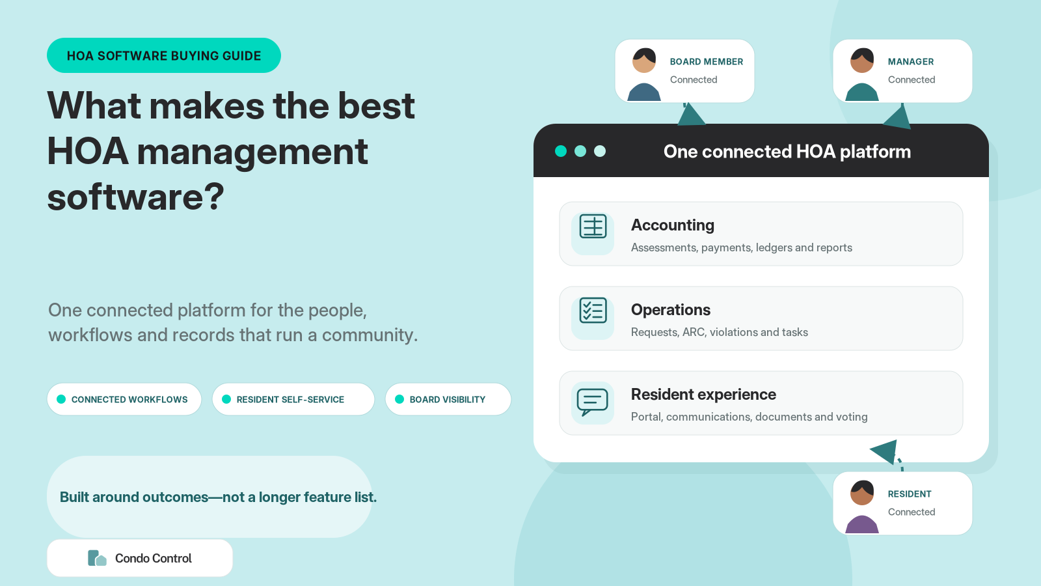
Giving homeowners self-service tools to pay monthly assessments and settle fines and late fees is an excellent way to streamline accounting. Establishing a resident payment portal accomplishes exactly that. A portal is simply an app-based or web-based platform that lets homeowners make payments, access association governing documents, and check their payment history and balances.
When the association adopts a self-service portal, it significantly cuts down the time spent doing manual data entry and payment processing. Usually, an online payment portal provides real-time reporting, making it easier for board members to track payments and reconcile accounts.
For instance, community association management platforms like Condo Control let residents pay using credit cards, ACH payment and pre-authorized debit for amenity use, fees, and related penalties. On the side of homeowners, they can access payment receipts, which prevents them from having to follow up on whether their payments have been received or not.
Automate AP
One of the frequent pain points that slows down community association management operations is the tedious and time-intensive accounts payable approval process. AP is simply the money the association owes to contractors, vendors, and service providers for work or supplies that have already been delivered. This might include management fees, insurance premiums, repair work, pool maintenance, and landscaping services.
Tracking accounts payable properly ensures the community stays financially healthy and prevents missed payments and late fees that could harm relationships with vendors. Also, it enables the board of directors to remain transparent to owners by maintaining clear documentation of liabilities and expenses. Each invoice needs to be reviewed, matched to the correct purchase order or contract, and approved by the board before issuing payment.
On average, manual AP takes 10-20 days, especially when receiving, coding, and approvals depend on paper documents, PDFs, and emails. When it comes to costs, Goldman Sachs research shows that one invoice costs around $22. Manual processing is also prone to human errors, with data entry mistakes averaging 3.6%.
Meanwhile, a Levvel Research study shows that businesses and companies using invoice automation platforms cut processing costs by up to 80% and reduce cycle times from weeks down to 3-5 days. Here’s how automated AP functions:
- Intelligent invoice data capture: Optical Character Recognition systems aided by AI pull information from various invoice formats, reducing manual entry and letting your team concentrate on reviewing.
- Automated coding: Pre-defined accounting rules categorize expenses and assign general ledger codes.
- Automatic routing: The system automatically directs invoices to the appropriate board members for approval depending on expense category, department, and dollar thresholds.
- Notifications: Board members get alerts through messaging platforms, their phones, and emails when an invoice requires review.
- Slack and mobile approvals: Board members can approve and green-light payments from anywhere. This prevents delays even when board members aren’t in the office.
- Smart fraud detection: Since all invoices are scanned by the AI, and the system can access all historical data, it can compare them to previous spending patterns and alert the board to unusual spikes. Also, monitoring expenses helps catch billing mistakes and prevent fraud, which ensures accountability.
Generate financial reports
The board is responsible for preparing the HOA statement. This statement lays out the liabilities, assets, expenses, and overall health of the association. What needs to be included in the statement depends on the association’s bylaws and state-specific regulations. However, the statement should include the following items regardless of where the association is located or how large it is:
- Balance sheet: It displays the association’s equity, liabilities, and assets
- Back statements: They outline the deposits and cleared debits
- General ledger: It shows all activities that have taken place in that account
- Bank reconciliations: They balance the ledger against the bank statements
- Receivables: These statements show the money still owed to the community
- Reserve fund balance: It shows the money the association has reserved to cover future expenses for pre-planned projects or emergencies
- Income statement: It details the money flowing into the association through fees, fines, and payments for amenity usage.
Keep in mind that many states have laws governing how the association must make the reports available to owners. For example, associations in Pennsylvania must follow the Nonprofit Corporation Law, which outlines members’ rights to examine and copy certain records if requested in writing during business hours.
California HOAs, on the other hand, must make records available for inspection and copying according to Civil Code Section 5205. This means the board is legally required to prepare these reports and make them accessible to owners.
With automation, you simply use the community association accounting software to generate the financial reports. Since all data exists within the system, you can create the report with one click. The reports are also more accurate because you’re not doing calculations manually.
AI-powered platforms built specifically for community associations like Condo Control even produce professional financial statements that comply with GAAP. This means board members don’t need accounting knowledge to prepare compliant financial statements.
Since the system runs on AI, it can summarize reports, show variations, and identify areas where the association is over budget or under budget.
Annual budget forecast
Budget planning is one of the hardest tasks for any community association. The good news is that AI can examine historical market trends and your community’s financial data and predict expenses more accurately. This helps board members prepare for upcoming expenses and avoid shortfalls.
Security
For many people, deciding to live in a residency governed by condo or homeowner associations comes with expectations of enhanced security. And that expectation comes with a responsibility on the part of board members. They need to come up with ways to protect the association assets, common areas, and residents. However, enhancing security is overwhelming when resident concerns, budgets, and legal requirements intersect.
Thankfully, AI-powered security platforms can significantly improve security through features like smart access control, fingerprints, automated surveillance, and facial recognition. When these features work together, they can help detect suspicious activities and prevent unauthorized entry. On top of that, these systems maintain timestamped logs of entry and exit. Board members can then use this data to manage the flow of people.
Final thoughts
Running a community isn’t hard, but without the right tools and strategies, it’s overwhelming and exhausting. Board members have lots of tasks to accomplish, from tracking fee payments, receiving and answering homeowner questions, processing invoices and paying contractors, to preparing financial statements and planning budgets. Fortunately, technology has advanced, and now we have AI platforms that can perform all that. With these platforms, board members can automate all the repetitive and time-consuming tasks and focus only on the tasks that require deep human thinking and judgment.