The residents in your communities aren’t comparing your response time to the other management companies. They’re measuring you against their bank’s instant chat, their package delivery tracker, and the help experience they get from their subscription apps. Research by LiveChatAI shows that around 60% of customers today define “immediate” as a reply within 10 minutes or less. And people aren’t benchmarking you against a similar service, but against the best experience they’ve had anywhere. That moving target is the invisible bar your residents carry into every request they send you.
To give you a sense of just how high that bar sits in other industries: fintech and banking companies aim to respond to emails within two hours and answer phone calls within sixty seconds. That’s the standard your residents expect from you. Now, when we move to community associations, an analysis of the 2022 CAI Homeowner Satisfaction Survey concluded that communication is the loudest complaint residents raise.
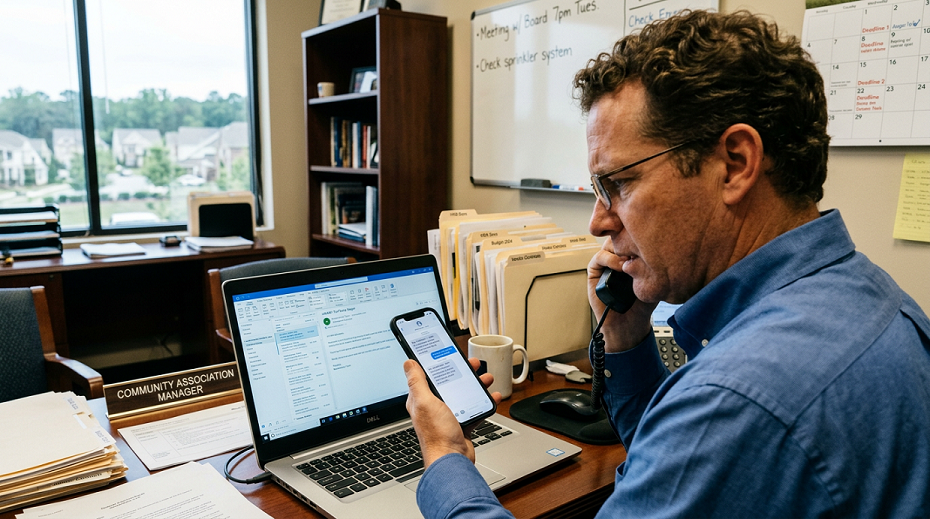
That tells you most managers aren’t meeting resident expectations when it comes to response time. That doesn’t mean you aren’t working hard. You’re just paying the real cost of channel-switching. So in this guide, I’ll walk you through what scattered SMS, email, and calls do to your response time, and then show you the benefits of centralizing everything.
Why channel-switching is a response-time problem

Before I get into why channel-switching is a response-time problem, let me start by assuring you that covering multiple channels is the right call. 72% of Millennials and Gen Z prefer texting as their primary communication method, compared to just 18% of Baby Boomers. A 2024 YouGov survey found that residents aged 18 to 24 lean strongly toward SMS (49%), while those 55 and older tend to reach for a phone or an email instead. That means dropping any channel isn’t an option, because doing so disadvantages a segment of the people you’re responsible for serving.
That said, coverage and responsiveness aren’t the same thing. Disconnected systems, where texts, emails, and calls are tracked separately with no shared record, increase time-to-resolution by as much as 26%. And across all industries, only 7% of organizations deliver seamless communication across channels. That means 93% are manually managing the gaps themselves. That manual gap management is what makes resolution slower. And here’s how that happens:
Every channel switch resets the context
When a resident texts you about something, your brain builds a picture of what’s happening: which property, which location, what was said, and what’s still unresolved. The moment you receive a phone call from a different community, that picture dissolves.
Let me start by showing you how dissatisfying this is. Salesforce’s 2024 State of Service report shows that 73% of customers expect to move from one channel to another without ever having to repeat themselves. Yet only 13% of organizations successfully carry conversation context across channels, and 93% of customers experience some information loss in that transition.
So when a resident who texted you calls back later and has to re-explain the entire situation from scratch, they lose confidence in you. In fact, the CMO Council found that 87% of customers grew frustrated when they had to repeat themselves across channels, and 73% of those customers began questioning whether the relationship was worth maintaining at all.
On your end, you’re spending time rebuilding a picture you’d already fully assembled once before. And because of this information loss during rebuilding, you end up not having the full info you need for faster resolution.
The same request gets treated as a separate issue
When a resident submits the same request on two or three different channels, each one gets picked up as if the others don’t exist. The burden of untangling that lands on you. And as you read the fragmented messages across different platforms, reconstruct a timeline, and decide which thread to reply in, more messages come in.
Industry research puts the cost of a repeat contact at 2 to 3 times higher than resolving the same issue on the first attempt. In community management, that cost is the extra hours you spend re-reading the same situation from three different angles before a single reply goes out. And those extra hours still reflect as a delayed response on the side of residents.
Follow-up messages spiral
When a resident reaches out and doesn’t hear back within a reasonable window, they reach out again, on a different channel, to make sure something happens. The structural problem this creates is that the message you’re seeing first isn’t always the one that was sent first. For example, a resident emails, hears nothing, and sends a text after one day.
That text lands in an inbox with zero visibility into the email. For the resident, the text is a follow-up with frustration of a delayed response. For you, the text doesn’t give you the info you need to act, as the complete picture only exists in the email you haven’t seen. That means you have to go through the other channels and reassemble everything before you can respond. In short, without visibility into aging conversations across channels, messages get buried, and you end up spending time reacting to escalations.
Lack of proper prioritization
Not every message you receive carries the same urgency. For example, a resident asking about the date of the next board meeting and a resident reporting a gas smell in the parking garage are different situations. But when both arrive as untagged messages across separate channels with no triage system in place, they look identical on arrival.
That’s the prioritization failure that scattered SMS, email, and calls create. Emergencies such as active flooding, electrical failures, and security breaches end up sitting in the same queue as requests to repaint a mailbox post or clarify a guest parking policy. But when we look at industry benchmarks, emergency repairs involving immediate safety risks require a response within four hours.
Urgent issues affecting residents’ daily functioning, such as a failing HVAC unit, require attention within 24 to 48 hours. Then the routine, non-urgent matters fall within a 3-7 day window. That said, meeting a four-hour emergency window isn’t realistic when you’re working through messages in arrival order across disconnected platforms, because you can’t determine a message’s urgency until you’ve already opened it, read it, and processed enough of it to classify it.
Institutional knowledge lives in personal devices
When a resident follows up on something they’d raised weeks earlier, the information you need might be existing somewhere else. Finding it means remembering which channel that original conversation happened on, and on which device. That means before you reply, you’re spending time just locating the prior exchange.
And let me show you how much that costs you. Research shows that knowledge workers spend about 20% of their workweek searching for information that already exists somewhere. Then there’s the deeper structural problem. When conversations happen on personal channels, the knowledge that comes out of those conversations gets permanently attached to the device and the person who received it. That means commitments, approvals, caveats, and previous decisions disappear into private threads, invisible to anyone who wasn’t part of the original exchange.
Cognitive overload
CAMs manage a portfolio of around 8-10 communities. Managing multiple channels simultaneously across such a portfolio degrades the quality of thinking you’re bringing to every response. And let me show you the research behind it.
A professor at the University of Washington’s Foster School of Business, Dr. Sophie Leroy, introduced the concept of “attention residue” in a 2009 paper: when you shift away from an unfinished task, part of your cognitive attention stays anchored to it rather than transferring fully to whatever comes next. The effect is strongest when the first task is unresolved and time-sensitive. So when you switch to your email inbox while still mentally holding the text thread, neither task is getting your full attention.
Then, a joint study by Qatalog and Cornell University found it takes an average of 9.5 minutes to return to a productive workflow after switching to a different digital application, and that’s before accounting for the attention residue effect Dr. Sophie Leroy identified, where part of your attention keeps processing the interrupted task even while you’re nominally focused on the new one. A sustained multitasking reduced cognitive performance by the equivalent of a 10-point IQ drop. Responses take longer to write, and more errors slip through.
Switching channels by itself takes time
Finally, there’s the time you spend not solving problems, not writing replies, not thinking through anything, but just moving between the places where messages live. Even on fast internet and good phones, it takes about 1+ second to open and load an email inbox, or load and open SMS conversations.
A global survey of 2,000 knowledge workers conducted by CITE Research on behalf of RingCentral found that 69% of employees waste up to 1 hour per day simply navigating between communication apps, about 32 full working days per person, per year.
When RingCentral revisited this question in their 2023 Communications at Work Index, the figure had grown to about 62 working days annually due to app toggling. If that’s the trend, it tells you the figure is worse in 2026. And that time we call “wasted” is actually time you’re actively trying to channel-switch, but for residents, it’s added response delays.
How centralizing channels fixes response time
The core shift here is simpler than it might sound. Instead of texts arriving in one place, emails in another, and call notes somewhere else, a centralized communication platform pulls all of it into one unified view. Let me use data to show you how important this is. Integrated omnichannel platforms cut wait times by 39% and reduce service costs by up to 35%. Here is the benefits breakdown:
Faster auto-acknowledgement
The follow-up spiral we described earlier, where silence drives a resident to reach out again on a different channel, creating a second record of the same issue and pushing the original message further back, has a surprisingly straightforward prevention mechanism: immediate, automatic acknowledgement. When a resident sends a message and receives near-instant confirmation that it arrived and is in the queue, the core driver of that spiral disappears.
And let me back this up with data. 89% of businesses across industries now use auto-replies to manage expectations at the point of first contact, and teams implementing them report saving up to 7 hours per week previously spent fielding follow-up inquiries and status check-ins. Research puts the follow-up reduction from a well-structured auto-acknowledgement at around 35%.
But the enabler of auto-acknowledgement is centralization, as the system can only operate when all your channels feed into the same platform.
Residents keep their preferred channel
A common problem about centralizing communication is that it forces everyone into one channel, solving the manager’s problem. But as we said, this is a problem for residents who prefer something different.
Instead of this route, you use multichannel intake, and then those channels get operationally connected on your side. A resident who prefers texting still texts. A resident who prefers email still emails. A resident who prefers calling still calls. But on your side, you get one shared view, one continuous history per resident, regardless of which channel any particular message came through.
And, as usual, let me back this up with data. Research from SQM Group found that customer satisfaction reaches 67% with smooth omnichannel support, compared to just 28% with disconnected multichannel support. IBM Institute for Business Value’s 2024 consumer research found that omnichannel experiences allowing customers to engage through their preferred channel without disruption lead to faster response times, less friction, and higher satisfaction.
Messages are visible to the whole team
When requests land in one person’s private inbox, no one else can see them, cover them, or even know they exist. That’s a point of failure that slows response time. But with centralization, messages arrive in a shared queue your entire team can see, and any available team member can spot what’s waiting and act on it. That improves time-to-first-response by 60 to 80% for routine communications.
Trackable message urgency
Prioritization only works when urgency is visible. A centralized platform makes it possible to tag, categorize, and sort messages by urgency at the point of intake, so what you’re looking at reflects actual priority, not just the sequence things came in.
There’s a compliance dimension here that makes urgency tracking more important. Some states have laws that impose deadlines for structural inspections and transparency requirements. For instance, in California, the Davis-Stirling Act sets statutory response timelines of 5, 10, or 30 days depending on the type of records requested. Once those windows expire without a response, the association is out of legal compliance. Trackable urgency in a centralized system means you see those windows before they close.
Final thoughts
Every minute you spend switching between tools, rebuilding context you already had, or reading the same issue across different threads is time that should be going toward an actual response. The good news is that the problem has a solution: centralizing where your messages arrive. That way, when a text, email, or call comes in, you see all of it in one place with full history, shared visibility across your team, and a structure that lets you respond to urgent issues first.