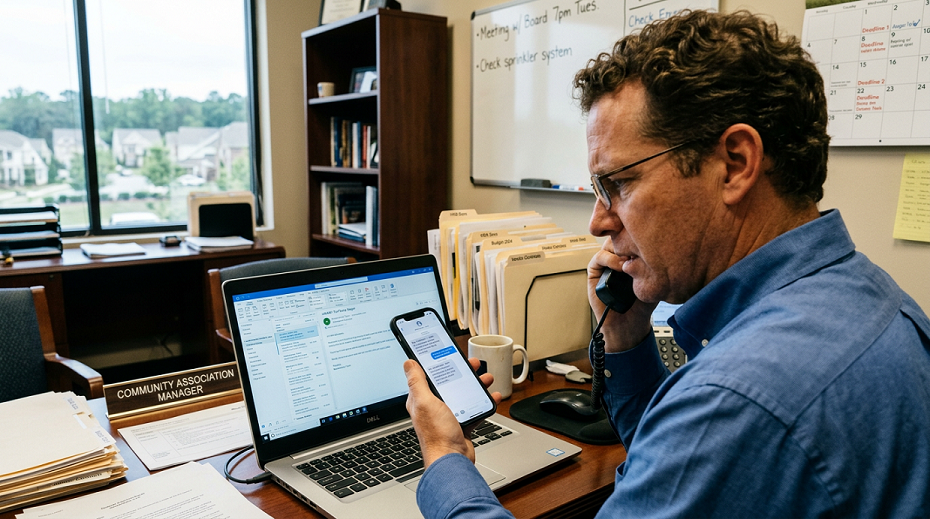
If I asked you right now what’s sitting on each of your managers’ plates, which board is waiting on a reserve study, which vendor still hasn’t called back, and which resident has emailed repeatedly about the same issue, could you answer without picking up the phone? For a lot of the management companies I talk with, the answer is no. Not because leadership isn’t paying attention, but because the industry has outgrown what any one person can hold in their head.
Close to 80 million residents are already living in a community association, which is about one in every three American households. And every one of those associations needs someone running it day to day. It’s rarely one manager per community. The going caseload lands somewhere between 8 and 12 communities per manager, each with its own board, budget calendar, vendor list, and reserve schedule.
Let’s pull the comparison outside our industry for a second. Gallup found that roughly two-thirds of managers oversee fewer than 10 people directly, and only 13% are responsible for 25 or more. A “direct report” in that data is about as simple as a working relationship gets: one person, one job description. A community association is nowhere close to that simple. Your managers know exactly what’s happening, and the information exists in their inbox, their call log, and in their heads. But because of the complexity and caseload, you can’t get that “direct report” without asking.
And when that gap develops across your portfolio, where a manager’s daily reality never makes it back to your desk, you’ll never have a way to tell what exactly is happening in each community right now. So that’s the ground I want to cover: what it costs when real-time visibility breaks down, and what to do to be able to see what your managers are handling right now.
What does it cost you when you can’t see the portfolio in real time?

I like reminding people that managers know exactly what’s happening in their communities. The information exists in a manager’s inbox, a spreadsheet nobody else had access to, or even a conversation that never got written down. It just never made it to the person who needed it in time to act. That gap between “someone knew” and “leadership knew” is where the cost lives, and here are some ways that’s going to cost you.
The caseload math won’t add up
Gallup’s 2025 workplace data puts the average number of direct reports per manager, across every industry, at 12.1, already a stretch by researchers who study span of control. But a direct report in that data is one person, one job description. A community association is a governing board with its own politics, a reserve schedule, a maintenance calendar, a full vendor roster, and a resident base that calls, emails, and shows up the moment something feels off.
When one manager runs ten or twelve of those in parallel, you’ve blown past what general management research treats as sustainable. Something has to give, and it’s almost always the leadership’s view of the whole portfolio, because the manager ends up being the only one who can see all of it at once.
Each manager runs a community as its own self-contained unit, and you lose the ability to catch an issue at one community before it repeats at the next. And this is a problem that happens to almost any business that outgrows a single location: the owner who once knew every regular by name can’t keep up once there’s a second one.
Bad news gets quieter the higher it climbs
Organizational psychologists call this the Hierarchical MUM Effect, the tendency for people to soften, delay, or round the edges off bad news the more layers it passes through on its way up a chain of command. Nobody’s lying exactly, but everybody’s smoothing it over a little, one level at a time, until a real problem barely resembles what started it by the time it reaches whoever’s in charge.
Let me give you an example. One analysis of this pattern in corporate settings found a case where a fix that would’ve cost roughly $50,000 caught early ballooned to nearly $500,000 after sitting unaddressed for six months. That’s purely because nobody upstream heard about it in time to act. If you take that case scenario and multiply by every manager in your portfolio running the same filtering process in parallel, whatever version of “how things are going” lands on your desk is probably calmer than what’s actually happening underneath it.
Delinquency numbers rise without you noticing
Every board treats a rising delinquency rate as a slow-moving problem, until it isn’t. Fannie Mae, Freddie Mac, and FHA all draw the same line: once 15% or more of a building’s units fall 60-plus days behind on assessments, the entire building loses eligibility for conventional financing, a penalty that lands on every owner, including those who’ve never missed a payment.
CAI puts a healthy delinquency rate between 5% and 8%, and buildings rarely leap from healthy to frozen overnight: a community at 12% today was likely closer to 8% six months ago, a trajectory only visible to someone tracking receivables over time. The stakes just went up, too: Fannie Mae retired its “Limited Review” shortcut this year, so as of August 2026, every condo sale requires the building’s delinquency rate to be verified before closing.
If you fail to keep track of the different delinquency trends your managers are handling, the problem will go unnoticed until it surfaces in the middle of an owner trying to sell their home.
Compliance deadlines expire without you noticing
Every community runs its own set of deadlines: inspection windows, records-request timelines, and notice periods that have to expire before a fine can be enforced. None of these things pauses because a manager is buried under other properties that week.
For example, under California’s SB 326 and SB 721, the balcony and elevated-walkway inspection statutes, missing an inspection deadline can trigger fines running into the thousands of dollars per day, on top of losing insurance coverage and exposing board members to personal liability. Records requests carry their own hard clock: California HOAs must produce current fiscal-year financial records within 10 business days of a member’s request, and prior-year records within 30 calendar days.
Even routine rule enforcement has an expiration date. Courts have sided with residents under the doctrines of waiver and laches, ruling a board forfeited its right to enforce a rule once it let violations slide long enough that people assumed nobody was watching.
High price tag on every manager who leaves
When information lives inside the manager’s inbox, personal Google Drive, and spreadsheets, what happens when they leave? You lose the working data. And just to let you see how serious this can get, workplace research shows that roughly 42% of what someone needs to know to do the job well is never documented. It exists only because they’ve been personally carrying it, and replacing them means burning through close to 200 hours relearning what they already knew, reconstructing a dozen relationships and half-finished projects from scratch.
Let me show you how serious this problem is. Turnover in property management sits at roughly 33%, 11 points above the 22% average across industries broadly. Layer on the Bureau of Labor Statistics’ projection of about 29,100 community association manager openings every year, and most exist because someone left. Your only solution to this unavoidable turnover rate is to maintain context of what’s happening in each community all the time, such that you can help a new hire catch up immediately.
How to build portfolio-wide visibility
If you ask management company owners if they have visibility into their portfolio, almost all will say yes. But if you push further and ask what that means day to day, you’ll get answers like a shared spreadsheet and periodic calls where every manager says “all good” because that’s the fastest way to get off it.
Most of what gets called “visibility” is just more data sitting in more places, not the same as actually seeing your portfolio. So here’s how to build a real portfolio-wide visibility:
Make it live, not reconstructed after the fact
Most of what passes for visibility here is a reconstruction pieced together after something’s already happened. For instance, you ask a manager what’s going on, they scroll back through old messages, and the answer was already out of date the moment you asked. IBM’s research found that roughly four out of five organizations are still basing decisions on information that nobody has verified recently, and 85% of data leaders admitted a decision made on outdated numbers had already cost their organization money.
You don’t want to go that route. Real visibility means looking at where a community actually stands right now, not a summary of where things stood the last time somebody checked. And that only means building an infrastructure that fetches real-time data as it flows through each community, such as live payment histories, and shows it on your dashboard. That way, every decision, even an answer given in an unexpected phone call, will be based on real, current data.
Centralize everything in one place
It’s not uncommon to find that a single manager’s day is scattered right now across tasks in one tool, work orders in another, financials in the accounting platform, and resident messages spread across email, text, and whatever app a board likes this year.
Salesforce found that work at the average business is spread across roughly eleven separate systems that don’t communicate with each other, and Aberdeen Group found that companies on properly connected systems make decisions roughly five times faster than those relying on people to manually carry information between tools.
For this problem, the fix is what IT teams call a “single pane of glass,” one place pulling in everything instead of different tools to stitch together. And I want to be clear about something: this usually isn’t a “get everyone to finally use software” problem. Specialized management software already sees adoption north of 89% among community managers and 75% among boards.
The tools already exist in nearly every one of your communities. What’s missing isn’t the software itself, but the layer above it, the one place that pulls every one of those separate systems into a single, portfolio-wide view. Implement that, and you won’t have to open new tabs and switch accounts just to see what a certain manager is handling. Everything will be visible from a single login screen.
Standardize the visibility
More visibility can make decisions worse if what’s tracked isn’t defined the same way by every manager. For example, one manager logs a violation notice as “sent” the day the letter goes out, and another only once the full notice period has run its course. Neither manager is wrong. They’re just working off their own definition. But when you roll both into a single portfolio-wide compliance number, it looks clean while telling you nothing true.
This problem has already been solved elsewhere when the WHO introduced a standardized surgical safety checklist across multiple hospitals. After the standardization, in-hospital deaths, surgical site infections, and reoperations all dropped by close to half. Standardizing the format of routine work is what makes it comparable at a glance, exactly what you need across ten or twenty managers, each running their own board, vendors, and version of demanding residents.
Make it trigger a decision
This leans more towards helping you make decisions, not just viewing raw data. Here’s a simple test: when a number moves, does it change what anyone does next? Let me give you an example. If you see 142 open tickets on the dashboard, it doesn’t tell anyone what to do differently today. But if the dashboard flags which managers are carrying more open tickets, and which of those are drifting toward a compliance deadline, you’ll know what to do.
The implementation should make the managers’ work easier
What we have covered so far is building an infrastructure that gives you portfolio-wide visibility. That’s good, but managers are the ones who will be interacting with the platform daily. The platform earns adoption by removing work from a manager’s day, not adding to it.
I mean, status should get pulled automatically from work a manager is already doing, such as closing a work order, or logging a resident call, rather than asking for a separate report describing work they just finished. A system that adds a step is a losing bet for someone juggling a dozen associations’ worth of open items. A system that removes one is the only version of visibility that’ll survive the caseload we talked about.
Final thoughts
Let me go back to the question I opened with: if I asked you whether you can see what your managers are handling right now, could you answer without picking up the phone? Most leaders in this industry can’t. And that happens because the industry is built on relationships and judgment calls, but the portfolio scales past what any one person can track from memory.
The fix is not to ask managers to create more reports or check in more often. It’s to build infrastructure that surfaces a portfolio-wide picture on its own: live, standardized, and specific enough to trigger a decision instead of just displaying a number. That way, you’ll have full supervision over your entire portfolio without calling managers and requesting reports.