Nearly 80 million Americans now live in HOAs, representing roughly a third of all U.S. housing stock. And that number keeps climbing. By the end of 2026, the total number of HOAs in the country is expected to approach 377,000, up from approximately 373,000 at the close of 2025. As communities grow, so do the expectations around what community life should actually feel like. Boards are investing in amenity upgrades, events, and experiences that bring neighbors together, strengthen community identity, and make residents proud of where they live.
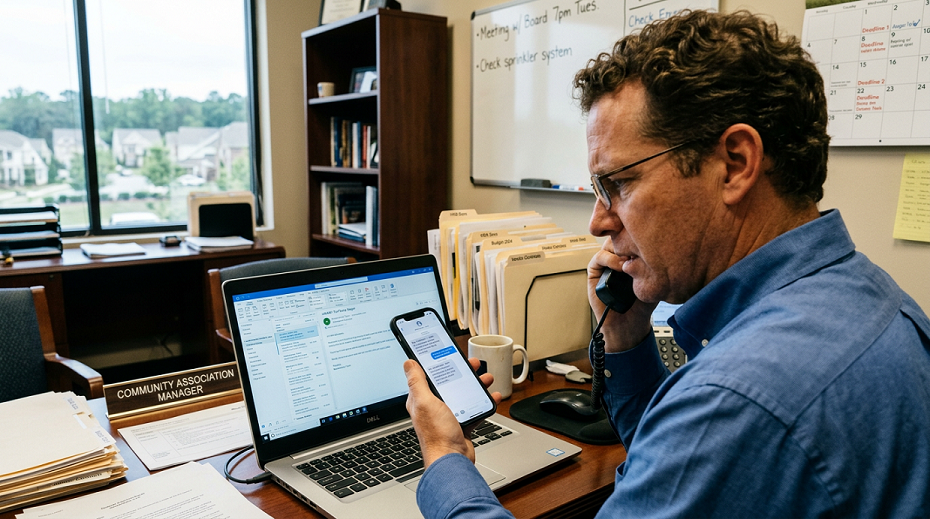
Events have become one of the most powerful tools in that effort. But here’s the reality: while HOA events have grown more ambitious and more central to community life, the way money gets collected at those events hasn’t kept up. Walk into most HOA events today, and you’ll still find a volunteer at the welcome table with a cash box, an envelope filling up with checks, and someone squinting at a handwritten list trying to track who’s paid.
And it’s not just a logistical inconvenience. When one person is responsible for handling all the cash at an event, you’ve already introduced the conditions for both honest mistakes and deliberate misuse. What makes this harder to justify is that your residents have largely moved on from cash everywhere else in their lives. Federal Reserve data shows cash was used in roughly 20% of all U.S. transactions in 2021, and by 2024, it had dropped to just 16%. Yet many HOA boards are still asking residents to show up to a summer cookout with the exact right change.
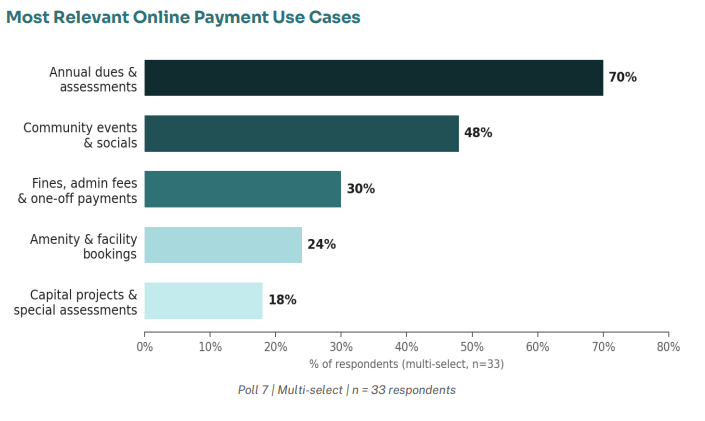
The disconnect is real, and boards are starting to feel it. In a recent webinar we hosted with 32 HOA leaders, 48% of attendees specifically identified community events and socials as a direct use case for online payments. That’s nearly half the room saying: we know this is a problem and we’re actively looking for a better answer. And in this guide, I’ll handle the problems with cash and checks when collecting payments at HOA events, and show you why you don’t need a checkbook.
The problem with cash and checks at events

When a volunteer sits down at the welcome table with an envelope and a handwritten list, three problems take root at the same time: no audit trail, no reliable record of who actually attended, and a manual counting job waiting at the end of the night. Here’s a breakdown of how these three problems are a financial control gap.
Audit trail
Cash doesn’t leave a digital footprint. There’s no timestamp, no name attached, and no record that the transaction ever happened unless someone physically wrote it down in the moment. In a volunteer-run HOA, where the same person collecting the money is the same person counting it at the end of the night, that’s a vulnerability.
The ACFE has long flagged this: skimming schemes, where cash is taken before it’s ever recorded, are among the hardest to detect because there’s nothing missing from the books. The money never made it into the books in the first place. Without a verifiable record, you’re not just exposed to fraud. You’re also exposed to honest mistakes that look like fraud, which can be just as damaging to trust within a volunteer board.
Attendee tracking
The attendee tracking problem runs just as deep. When payments come in at the door in the form of cash in hand or a check tucked into an envelope, there’s no automatic link between that payment and a specific resident. You end up with a pile of money and a handwritten list, and at some point, someone has to reconcile the two.
Imagine realizing two days before an event that your attendance list shows 150 people, but your payment records only account for 120, and you have no clean way to figure out who’s missing. And that’s not a hypothetical. It’s the kind of scramble that event organizers deal with regularly, and it’s a big part of why 85% of professional event planners have moved to dedicated event management tools. For HOA boards running everything on volunteer time, that same chaos hits, but using a different event management tool just complicates things, as the HOA finances will need reconciliation after. So, for HOAs, it’s about having a management platform that incorporates event payment collection as a feature.
Manual counting
Then there’s the counting itself. After everyone’s gone home, a tired volunteer has to sit down and physically count every bill, sort every check, and try to make the total match whatever attendance record survived the evening. And remember that when people are rushing, distracted, and just worn out from running the event, miscounts happen.
How event-specific payment campaigns work
The alternative to the cash box isn’t complicated. You create a dedicated payment page for a single event, share it as a link or QR code, and every transaction that comes through is automatically tracked – who paid, when, and how much. Here are the mechanics to do it.
Once the payment page is up and you have the unique link, share it wherever your residents are already paying attention, such as the community newsletter, a group chat, or the event flyer posted at the mailboxes. Residents don’t need to download an app or create an account. They click the link, pay from whatever device is in their hand, and receive an automatic confirmation. Payments start coming in before the event even happens, and you can watch them arrive in real time without touching a spreadsheet. From your side, the dashboard updates itself.
What makes the per-event structure so good for HOA boards is the clean separation of data. Instead of every community payment funneling into one master account that someone has to sort through later, each event has its own campaign, which means its own records. For example, when your treasurer needs to report on what the summer barbecue generated versus what the holiday party cost, those numbers are already organized.
The range of events where HOA leaders want this capability is broader than you might expect. In that same webinar, 63% of attendees said a fundraiser was the scenario where they’d most want to manage payments online, which makes sense, given the higher financial stakes and the need for clean records when donations are involved.
Recreation events came in second at 22%, and community improvement projects, like a neighborhood garden initiative, were chosen by 15%. What that tells me is that boards aren’t just thinking about this for big formal events. They want it for the full range of activities they actually run throughout the year. In fact, one attendee from a social group, not a traditional HOA, also asked whether they could use this kind of tool on a one-off basis without any long-term commitment. This question reflects how widely this need extends beyond formal HOA structures.
For events where a printed flyer is doing the communication work, such as a flyer pinned on the community board or tucked into a welcome packet, a QR code carries the same payment link in physical form. A resident points their phone camera at the code and lands directly on the payment page.
On-site collection
Setting up the payment campaign ahead of time handles a lot. But what happens when the doors actually open matters just as much, and the on-site experience changes significantly when you replace the cash table with digital collection.
The most visible change is at the door. Instead of a volunteer managing a cash box, a QR code on a banner, a lanyard, or a table does the same job without any of the risks. A resident walks up, points their phone at the code, and the payment is done in seconds. No wallet, no change, no handoffs. For an HOA cookout or holiday market, your entire payment infrastructure for the event is essentially a printed sheet of paper, and lines keep moving because residents aren’t digging through pockets while others wait behind them.
Something worth mentioning is that the payment page should be built for the phone already in your resident’s hand, without requiring an app download or account creation. The reason I had to mention this is because 84% of consumers say convenience is their top priority when choosing how to pay, and roughly half say transaction speed is essential. When the payment experience takes less time than the greeting, the whole entry flow gets smoother.
The less obvious but equally important advantage is what happens when your event is large enough to need more than one person collecting payments. I’m saying this because this question came up in our webinar, when an attendee asked: “Can multiple members accept payments at an event? Do we need to bring our iPad or phone?” Let’s first look at it from the manual angle. With a cash setup, three volunteers collecting simultaneously creates a logistical mess: whose envelope is whose, who reconciles what, and how do the totals combine without errors?
With a shared payment link, that problem simply doesn’t exist. Each volunteer uses a printed QR code or their own mobile device; every transaction flows into the same dashboard in real time, and nothing needs to be manually combined at the end of the night. Every payment is tagged, timestamped, and accounted for without anyone having to count a single bill.
Beyond payment: using payment records as an attendee list, check-in tool, and post-event report
The shift starts the moment a resident pays. As soon as payment is confirmed, that person is on your list – not a list someone has to manually update, but one that builds itself in real time as registrations come in. By the time your event starts, the volunteer at the door already has an accurate, complete record of everyone who’s paid. They’re not guessing and asking people to spell their last names. The list exists, and it’s right, because your residents built it themselves when they registered.
Check-in becomes just as clean. A QR code scan at the entrance marks someone as arrived, eliminates handwriting errors, and keeps the line moving. In our webinar, one attendee made this observation, so I had to mention it. They noted that a tool like this “could be used as a check-in list.” The payment record and the attendance record are the same record.
What you’re left with at the end of the night isn’t a pile of envelopes and a vague memory of who showed up. It’s a document of record, exportable, audit-ready, and already organized. And that report is one of the most useful things when it comes to decision-making. For example, a board that knows the fall festival drew 94 paid residents while the spring mixer drew 31 has actual numbers to inform next year’s event budget.
The financial side feeds directly into your broader online payment accounting obligations as well. Every HOA has a responsibility to maintain accurate financial records for reporting, budgeting, and compliance. And when event revenue flows through a digital system from the start, those records don’t need to be manually prepared. They’re already there, already clean, and already attached to the people who generated them.
Final thoughts
More than two billion people globally use mobile payments in their daily lives. The residents walking through the door at your next community event are the same people who split dinner bills, buy concert tickets, and pay their utilities entirely from their phones. Asking them to bring cash or write a check to attend a neighborhood gathering creates friction that has nothing to do with the event itself, and it signals that your community’s operations haven’t kept pace with them.
The solution is to set up a dedicated collection page for each event. A link or QR code goes out in the newsletter or community group chat, and payments start arriving before the event. Residents confirm attendance and pay in a single step. Then the payment processing, reconciliation, and record-keeping happen automatically, saving the board from human errors, risks of handling cash, and hours of administrative work.